Maximizing Social Security: 5 Insider Strategies for 2026 Payouts

Maximizing Your Social Security Benefits in 2026: 5 Insider Strategies to Boost Your Annual Payout by 15%
For many Americans, Social Security represents a cornerstone of their retirement income, a financial lifeline that provides essential support during their golden years. As we look ahead to 2026, understanding how to effectively maximize social security benefits becomes more critical than ever. With potential adjustments to cost-of-living allowances (COLAs) and evolving economic landscapes, strategic planning can significantly impact your annual payout, potentially boosting it by a remarkable 15% or more. This comprehensive guide will delve into five insider strategies designed to help you navigate the complexities of Social Security and secure the highest possible benefits for your retirement.
The decisions you make regarding Social Security are among the most important financial choices of your life. These decisions are not just about when to claim, but also about understanding your work history, spousal benefits, and even how to handle taxes on your benefits. Ignoring these crucial aspects can leave significant money on the table, money that could otherwise enhance your retirement lifestyle or provide a much-needed buffer against unexpected expenses. Our goal today is to equip you with the knowledge and actionable steps to ensure you are not leaving any of your hard-earned benefits unclaimed.
Let’s embark on this journey to optimize your Social Security and build a more financially secure future.
Strategy 1: Delaying Your Claim for Maximum Growth
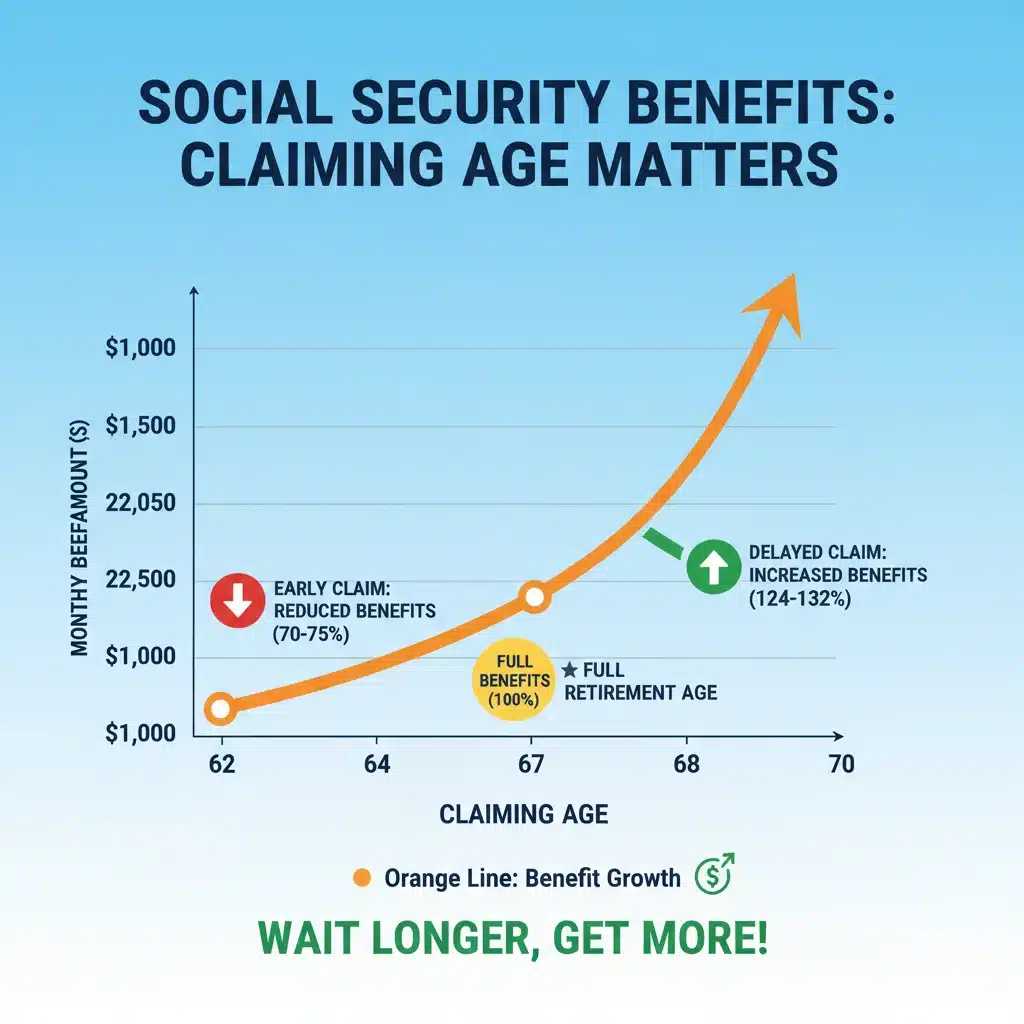
Perhaps the most widely discussed, yet often misunderstood, strategy to maximize social security benefits is delaying your claim. While you can start receiving benefits as early as age 62, doing so comes with a significant reduction in your monthly payout. Conversely, waiting beyond your Full Retirement Age (FRA) can lead to substantial increases in your annual benefits, thanks to Delayed Retirement Credits (DRCs).
Understanding Full Retirement Age (FRA)
Your Full Retirement Age (FRA) is the age at which you are entitled to 100% of your primary insurance amount (PIA). This age varies depending on your birth year. For those born in 1943 through 1954, FRA is 66. For those born in 1960 or later, FRA is 67. If you were born between these years, your FRA falls somewhere in between. Knowing your specific FRA is the foundation for making informed claiming decisions.
The Power of Delayed Retirement Credits (DRCs)
For every year you delay claiming benefits past your FRA, up to age 70, your monthly benefit amount increases by a certain percentage – typically around 8% per year. This is a guaranteed, inflation-adjusted return on your decision to wait, a return that is hard to beat in most other investment vehicles. For example, if your FRA is 67 and you delay claiming until age 70, you could increase your monthly benefit by approximately 24% (3 years x 8% per year). This compounding effect over a lifetime of retirement can translate into tens of thousands, if not hundreds of thousands, of additional dollars.
When Delaying Makes Sense
Delaying isn’t for everyone, but it’s a powerful strategy for those who can afford it. Consider delaying if:
- You are in good health and expect to have a long lifespan: The longer you live, the more you benefit from the higher monthly payouts.
- You have other sources of income: If you can comfortably cover your living expenses with savings, pensions, or continued work, delaying your Social Security claim becomes a financially viable option.
- You want to provide a higher survivor benefit: If you are married, your delayed benefits can also translate into a higher survivor benefit for your spouse if you pass away first.
It’s crucial to analyze your personal financial situation, health, and life expectancy before making this decision. A financial advisor can help you project how delaying benefits would impact your overall retirement income.
Strategy 2: Optimizing Spousal and Survivor Benefits
Social Security isn’t just about individual benefits; it also offers significant provisions for spouses and survivors. Understanding these rules can be a game-changer for married couples and those who have lost a loved one, enabling them to significantly maximize social security payouts.
Spousal Benefits: A Strategic Partnership
If you are married, you may be eligible to receive spousal benefits based on your spouse’s work record, even if you have your own work history. A spousal benefit can be up to 50% of your spouse’s Full Retirement Age (FRA) benefit. However, you cannot claim spousal benefits until your spouse has filed for their own benefits. There are also specific rules about claiming your own benefit versus a spousal benefit that can be strategically managed.
- "File and Suspend" (for those born before January 2, 1954): While largely eliminated by the Bipartisan Budget Act of 2015, some individuals who were born before January 2, 1954, may still be able to utilize a "file and suspend" strategy. This allowed one spouse to file for benefits at FRA, allowing the other spouse to claim spousal benefits, while the filing spouse’s own benefits continued to accrue Delayed Retirement Credits. If this applies to you, seek immediate expert advice.
- "Restricted Application" (for those born before January 2, 1954): Another strategy for this specific age group allows an individual to claim only spousal benefits at their FRA, while their own benefits continue to grow until age 70. At age 70, they can then switch to their own higher benefit. This is a powerful way to maximize social security for couples.
- Modern Spousal Strategies: For those born after the cutoff, the rules are simpler but still require careful planning. Generally, you can claim your own benefit or a spousal benefit (whichever is higher), but not both simultaneously in a way that allows your own benefit to grow. The key is coordinating claiming ages to ensure the higher earner delays their claim to maximize the primary benefit, which then also maximizes the potential spousal and survivor benefits.
Survivor Benefits: A Safety Net
If your spouse passes away, you may be eligible for survivor benefits. These benefits can be up to 100% of the deceased spouse’s benefit amount. The earliest you can claim survivor benefits is age 60 (or age 50 if you are disabled). However, similar to individual retirement benefits, claiming survivor benefits before your own FRA will result in a reduction. A crucial strategy here is to understand if you can claim survivor benefits first, and then switch to your own higher retirement benefit at age 70, or vice versa, depending on which benefit is higher. This requires careful calculation and understanding of your specific circumstances.
For complex family situations, including divorced spouses, specific rules apply. A divorced spouse may be eligible for benefits based on an ex-spouse’s record if the marriage lasted at least 10 years, they are currently unmarried, and are at least age 62. These benefits do not affect the ex-spouse’s benefits or their current spouse’s benefits. Understanding these nuances is key to fully maximize social security benefits for all eligible parties.
Strategy 3: Reviewing Your Earnings Record Annually
Your Social Security benefits are calculated based on your highest 35 years of earnings. An error in your earnings record, even a small one, can significantly reduce your benefit amount over your lifetime. This is why regularly reviewing your earnings history is a simple yet incredibly effective strategy to maximize social security.
Why Your Earnings Record Matters
The Social Security Administration (SSA) uses your reported earnings to calculate your Average Indexed Monthly Earnings (AIME), which then determines your Primary Insurance Amount (PIA). If any of your earnings are missing or incorrectly recorded, your AIME will be lower, leading to a reduced PIA and a smaller monthly benefit.
How to Review Your Earnings Record
The process is straightforward:
- Create a "my Social Security" account: Visit the official SSA website (ssa.gov) and create a free, secure online account. This account provides access to your personalized Social Security Statement.
- Review your Social Security Statement: Your statement details your earnings history year by year. Carefully check each year’s reported earnings against your W-2s or tax returns. Pay close attention to years with high earnings, as these have the most significant impact on your benefit calculation.
- Look for discrepancies: If you find any discrepancies, such as missing years of earnings or incorrect amounts, contact the SSA immediately. You’ll need to provide documentation, such as W-2s, pay stubs, or tax returns, to support your claim.
Even if you’re years away from retirement, it’s wise to make this an annual habit. Correcting errors can take time, so addressing them early ensures that your earnings record is accurate when it’s time to claim your benefits. This proactive approach is a fundamental step to maximize social security.
Strategy 4: Continuing to Work in Retirement (Strategically)
Working in retirement can not only provide additional income but can also be a powerful tool to maximize social security benefits, especially if you haven’t yet reached your Full Retirement Age (FRA).
The Earnings Test: What You Need to Know
If you claim Social Security benefits before your FRA and continue to work, your benefits may be reduced if your earnings exceed certain limits. This is known as the "earnings test."
- Before FRA: If you are under FRA for the entire year, the SSA deducts $1 from your benefits for every $2 you earn above a certain annual limit (e.g., $22,320 in 2024).
- In the year you reach FRA: In the year you reach your FRA, the SSA deducts $1 from your benefits for every $3 you earn above a different, higher annual limit (e.g., $59,520 in 2024), but only counting earnings before the month you reach FRA.
- At or after FRA: Once you reach your FRA, the earnings test no longer applies, and you can earn as much as you want without your Social Security benefits being reduced.
How Working Can Boost Your Benefits
Even with the earnings test, working can still help maximize social security in several ways:
- Replaces Low-Earning Years: Remember that your benefit is based on your highest 35 years of earnings. If you continue to work and earn more in your later years than in some of your earlier, lower-earning years, your Social Security benefit will be recalculated to replace those lower years with higher ones, resulting in a larger monthly payout.
- Delays Claiming: Working longer can allow you to delay claiming your benefits until your FRA or even age 70, taking full advantage of Delayed Retirement Credits (DRCs). The income from your work helps bridge the gap until you claim your higher benefit.
- Reduces Dependence on Benefits: By having additional income from work, you reduce your immediate reliance on Social Security, giving you more flexibility in your claiming decision and potentially allowing you to delay for a higher benefit.
Careful consideration of the earnings test limits and your overall financial picture is essential. Sometimes, the temporary reduction in benefits due to the earnings test can be offset by the long-term gain of replacing low-earning years or delaying your claim. Consult with a financial advisor to strategize the best approach for your unique situation.

Strategy 5: Understanding and Minimizing Taxation on Benefits
While often overlooked, the taxation of Social Security benefits can significantly impact your net payout. Strategic planning to understand and potentially minimize these taxes is a crucial step to truly maximize social security.
How Social Security Benefits Are Taxed
Whether your Social Security benefits are taxable depends on your "provisional income." Provisional income is calculated as the sum of your adjusted gross income (AGI), any tax-exempt interest (like from municipal bonds), and half of your Social Security benefits.
- Up to 50% of your benefits may be taxable: If your provisional income is between $25,000 and $34,000 for an individual, or between $32,000 and $44,000 for those filing jointly, up to 50% of your Social Security benefits may be subject to federal income tax.
- Up to 85% of your benefits may be taxable: If your provisional income exceeds $34,000 for an individual or $44,000 for those filing jointly, up to 85% of your Social Security benefits may be subject to federal income tax.
It’s also important to note that some states also tax Social Security benefits, adding another layer of complexity. As of 2024, there are 11 states that tax Social Security benefits to some extent: Colorado, Connecticut, Kansas, Minnesota, Montana, Nebraska, New Mexico, Rhode Island, Utah, Vermont, and West Virginia. This list can change, so it’s vital to check your state’s current regulations.
Strategies to Minimize Taxation
While you can’t avoid taxation entirely if your income is above the thresholds, you can employ strategies to manage your provisional income and potentially reduce the taxable portion of your benefits:
- Strategic Retirement Account Withdrawals: Consider the timing and type of withdrawals from your retirement accounts. For instance, converting traditional IRA funds to a Roth IRA in lower-income years before claiming Social Security can reduce future taxable income. Similarly, drawing down tax-deferred accounts (like traditional IRAs or 401(k)s) strategically can help manage your provisional income.
- Managing Other Income Sources: If possible, adjust the timing of other taxable income, such as capital gains from investments or distributions from non-qualified annuities, to keep your provisional income below the Social Security tax thresholds.
- Tax-Efficient Investments: Invest in tax-efficient vehicles, such as Roth IRAs, Roth 401(k)s, or municipal bonds (for tax-exempt interest), to generate income that doesn’t contribute to your provisional income or is tax-free in retirement.
- Professional Tax Planning: A qualified tax advisor specializing in retirement planning can provide personalized strategies to minimize the impact of taxes on your Social Security benefits, ensuring you truly maximize social security net payouts.
Understanding the interplay between your income sources and Social Security taxation is crucial for effective retirement planning. A seemingly small tax burden can accumulate over years, significantly eroding your overall benefits.
The Broader Picture: Integrating Social Security into Your Retirement Plan
While these five strategies focus on how to maximize social security benefits, it’s vital to view them as part of a larger, holistic retirement plan. Social Security is a critical component, but it rarely covers 100% of retirement expenses. Therefore, integrating your Social Security strategy with your other financial assets and goals is paramount.
When to Start Planning
The best time to start planning for Social Security is not just a few years before retirement, but much earlier. Understanding your potential benefits, your FRA, and the impact of various claiming ages can influence your savings rate, investment choices, and even career trajectory. Many individuals begin to seriously consider their Social Security options in their late 50s or early 60s, but even in your 30s and 40s, understanding the basics can empower better long-term financial decisions.
The Role of Professional Advice
Social Security rules are complex and can change. The strategies discussed here are general guidelines, but your personal circumstances – including your health, marital status, other income sources, and desired lifestyle – will dictate the optimal approach for you. A qualified financial advisor who specializes in retirement planning can provide invaluable assistance. They can:
- Analyze your specific earnings record and projections.
- Model different claiming scenarios to show the long-term impact on your income.
- Help you coordinate Social Security with your other retirement assets.
- Advise on spousal and survivor benefit options.
- Guide you through potential tax implications.
Engaging with a professional ensures that you are making the most informed decisions to maximize social security and achieve your retirement dreams.
Conclusion: Your Path to Maximized Social Security in 2026
As you prepare for retirement in 2026 and beyond, the power to significantly maximize social security benefits is largely in your hands. By diligently applying these five insider strategies – strategically delaying your claim, optimizing spousal and survivor benefits, meticulously reviewing your earnings record, leveraging strategic work in retirement, and minimizing taxation on benefits – you can substantially increase your annual payout. Remember, these decisions have long-term consequences, impacting your financial security and quality of life throughout retirement.
Don’t leave money on the table. Take the time to educate yourself, review your personal situation, and if necessary, seek expert guidance. Your proactive efforts today will pave the way for a more comfortable, secure, and prosperous retirement tomorrow. Start planning now to ensure you unlock every dollar you’re entitled to from Social Security.